Tuesday, 30 December 2025

How I Help Small Businesses Survive (and Thrive) in the Zero-Click Search Era

Imagine spending months optimizing a client’s website to rank #1 on Google, only to discover that their target customers are getting their answers without ever clicking through. Welcome to the era of zero-click searches—where Google’s AI Overviews, featured snippets, and knowledge panels provide immediate answers directly on the search results page.

As someone who’s been doing digital marketing for over 8 years, I’ll admit this trend initially concerned me. After all, if people aren’t clicking through to websites, how can I help my clients convert them into customers? But here’s what I’ve learned: zero-click searches aren’t the death knell for small business marketing—they’re an evolution that requires a strategic response.

And honestly? I’ve found that some of my clients are getting better results in this new landscape than they ever did before.

In this comprehensive guide, I’ll share exactly how I’m adapting my digital marketing strategies—and getting results—in the zero-click search landscape.
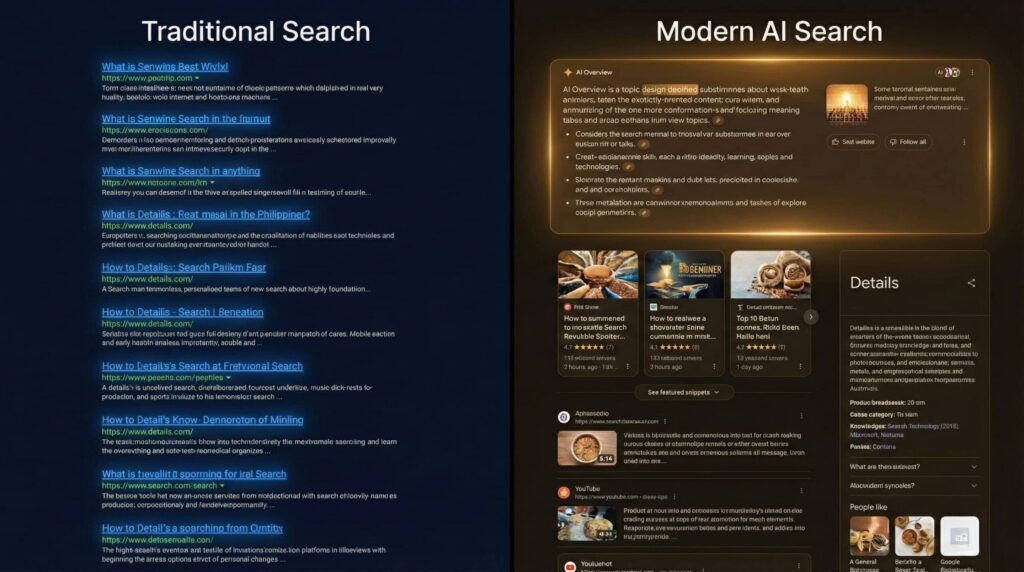
Side-by-side comparison of traditional Google search results versus modern zero-click features like AI Overview and featured snippets

Understanding What’s Really Happening with Zero-Click Searches

Zero-click searches occur when users get the information they need directly from the search results page without clicking through to any website. As someone who monitors these trends closely for my clients, I’ve watched Google expand these features aggressively over the past few years, and the acceleration has been dramatic with AI Overviews.

The Numbers I’m Seeing

Let me share the data that’s shaping how I approach client work:

Why Google Is Doing This (And Why I’m Not Fighting It)

Understanding Google’s motivation has helped me develop better strategies for my clients. Google wants to:

  • Keep users on their platform longer to show more ads
  • Provide faster answers to improve user satisfaction
  • Compete with AI chatbots like ChatGPT that answer questions directly
  • Increase mobile engagement where quick answers are particularly valuable

Here’s my perspective after 8+ years in this field: Google still needs quality content to power these features—and I can make your business the source they cite and feature.
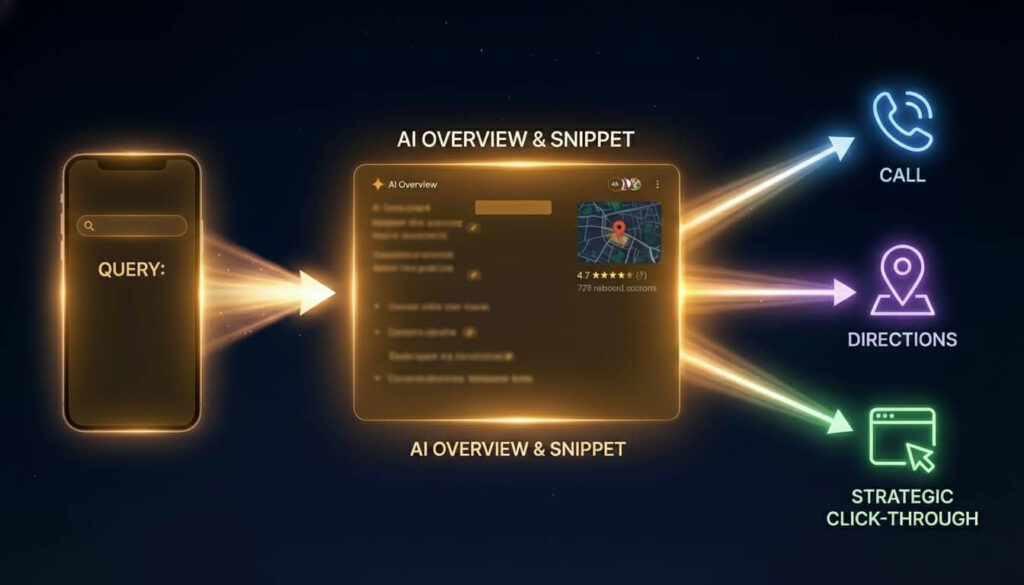
User journey flowchart for zero-click searches showing query to AI Overview to customer action

The Different Types of Zero-Click Features I’m Optimizing For

Different zero-click features serve different purposes, and I’ve developed specific optimization strategies for each based on what’s actually working.

AI Overviews (Formerly SGE)

Google’s AI-powered summaries synthesize information from multiple sources. I’m seeing these appear at the top of results for many informational searches, and they often include citations to 2-6 source websites.

What I’m Noticing:

  • Multi-source synthesis
  • Conversational tone
  • Follow-up question suggestions
  • Citations that actually link out

Featured Snippets

These are the highlighted answer boxes above organic results. I’ve had great success capturing these for my clients because they provide prominent visibility.

Types I’m Targeting:

  • Paragraph snippets (definitions, explanations)
  • List snippets (steps, rankings, items)
  • Table snippets (comparisons, data)
  • Video snippets (how-to content)

Knowledge Panels

These information boxes appear on the right side (desktop) or top (mobile) and provide instant access to key business facts. For my local business clients, these are gold.

What They Include:

  • Business contact information
  • Photos and reviews
  • Operating hours
  • Direct action buttons (call, directions, website)

Local Pack Results

For local searches, Google displays a map with three business listings. I’ve found that getting clients into this Local Pack often drives more phone calls than traditional rankings ever did.

My Local SEO services focus heavily on Local Pack visibility.

Why I Tell Clients Zero-Click Isn’t Actually Bad

Before I dive into strategies, let me reframe how I think about zero-click searches—because this mindset shift has been crucial for my clients.

Enhanced Brand Visibility

When I get a client featured in a snippet or AI Overview, I’m putting their business front and center on the search results page—often above all traditional organic results. This prime real estate provides brand exposure even if users don’t immediately click.

Trust and Authority Signals

When Google features your content, I see it as a powerful third-party endorsement. Users perceive featured sources as more authoritative and trustworthy—and that’s invaluable.

More Qualified Traffic When Clicks Do Occur

Here’s something interesting I’ve observed: users who click through after reading a snippet or AI Overview are often more qualified and further along in their decision-making process. They’re clicking because they want more detailed information or are ready to take action.

Capturing High-Intent Local Searches

For my local business clients, zero-click features like the Local Pack and knowledge panels make it easier for customers to take immediate action—calling the business or getting directions. In many cases, I’ve found this is even more valuable than a website visit.

My Strategic Response to Zero-Click Searches

Now let me share the actionable strategies I’m using to help clients benefit from zero-click features.

Strategy 1: Capturing Featured Snippets

Featured snippets represent one of the best opportunities I’ve found for small businesses. They provide prominent visibility and can be captured through strategic content optimization.

My Process for Winning Featured Snippets:

  1. I identify snippet opportunities using tools like Ahrefs and SEMrush, plus manual Google searches for target keywords. I look for queries where a snippet already exists but isn’t from my client’s site.
  2. I structure content for snippet extraction:
    • Clear, concise paragraph answers (40-60 words) for definition queries
    • Numbered or bulleted lists for process or ranking queries
    • HTML tables for comparison or data queries
    • Placement of snippet-worthy content near the top of the page
  3. I answer the question directly first, then provide expanded detail. I’ve learned Google favors content that gets straight to the point.
  4. I use the exact question as a heading (H2 or H3), then provide the answer immediately below.

Example Format I Use:

## How Much Does Kitchen Remodeling Cost in Phoenix?

Kitchen remodeling in Phoenix typically costs between $15,000 and $45,000, with most homeowners spending around $25,000 for a mid-range renovation. The final cost depends on the size of your kitchen, the materials you select, and the extent of structural changes required.

[Followed by detailed breakdown...]

Strategy 2: Implementing Schema Markup

I always implement schema markup for my clients—it’s structured data code that helps Google understand your content and extract it for various zero-click features.

My Priority Schema Types:

  • LocalBusiness Schema: I ensure accurate information in knowledge panels and local results
  • FAQ Schema: I make Q&A content eligible for direct inclusion in search results
  • HowTo Schema: I optimize step-by-step guides for featured snippet inclusion
  • Product Schema: I display pricing, availability, and reviews in search results
  • Review Schema: I showcase ratings prominently

The technical implementation requires adding specific code to your website. It’s one of my core services because the payoff in increased visibility is substantial.

My Web Design & Development team can implement schema markup across your site.

Strategy 3: Creating Question-Focused Content

I’ve learned that AI Overviews and featured snippets favor content that thoroughly answers user questions. This means I create detailed resources rather than thin, promotional pages.

My Content Framework:

  1. I open with a direct answer (snippet-worthy)
  2. I provide context and background (builds authority)
  3. I offer detailed explanations (encourages clicks for more info)
  4. I include related questions (captures PAA opportunities)
  5. I add clear calls-to-action (converts traffic that does click)

Topics I’m Creating That Perform Well:

  • “How much does [your service] cost in [your city]?”
  • “How to choose the right [your industry] professional”
  • “What to expect during [your service process]”
  • “[Your service] checklist: A complete guide”
  • “DIY vs. professional [your service]: Which is right for you?”

Strategy 4: Dominating Google Business Profiles

For my local business clients, the Google Business Profile is the foundation of zero-click presence. An optimized profile can generate phone calls, direction requests, and website visits directly from search results.

My GBP Optimization Checklist:

✓ I complete every field with accurate information
✓ I select all relevant business categories (primary and secondary)
✓ I upload high-quality photos regularly (I aim for 20+ photos minimum)
✓ I post weekly updates, offers, or announcements for my clients
✓ I respond to every review within 24 hours
✓ I add all services with detailed descriptions
✓ I include relevant attributes
✓ I use Google Q&A to address common customer questions
✓ I enable messaging to allow direct communication

Pro Tip from My Experience: Businesses with complete, active Google Business Profiles receive 70% more location visits and 50% more consideration for purchases. I’ve seen this proven with my own clients time and again.

Strategy 5: Building Authority Through Consistent Content

I’ve learned that Google selects sources for AI Overviews and featured snippets based largely on authority signals. Building topical authority in your niche increases your chances of being featured—and I make this a cornerstone of my work.

My Authority-Building Content Strategy:

  • I publish consistently (at least 2-4 blog posts monthly for clients who invest in content)
  • I go deep on topics (2,000+ word comprehensive guides)
  • I create topic clusters (one pillar page with 8-10 supporting articles)
  • I update existing content regularly with new information
  • I build quality backlinks through outreach and partnerships
  • I demonstrate expertise with case studies, data, and specific examples

Strategy 6: Optimizing for “Near Me” and Local Intent

Local searches often result in zero-clicks through the Local Pack, but I’ve found they also drive high-intent actions like phone calls and direction requests.

My Local Optimization Tactics:

  • I include city/region naturally throughout content
  • I create location-specific service pages for each area clients serve
  • I publish local content (neighborhood guides, local events, community involvement)
  • I maintain consistent NAP (Name, Address, Phone) across all platforms
  • I encourage reviews that mention specific services and locations
  • I include local landmarks and references in content

Strategy 7: Targeting Transactional Intent

While informational queries often end in zero clicks, I’ve learned that transactional and commercial investigation queries more frequently result in website visits. I balance content strategy accordingly.

How I Think About Query Types:

Informational (often zero-click):

  • “What is [topic]”
  • “How does [thing] work”
  • “When should I [action]”

Commercial Investigation (mixed):

  • “Best [product/service] for [need]”
  • “[Product/service] reviews”
  • “[Service] cost in [location]”

Transactional (usually clicks):

  • “[Service] near me”
  • “Buy [product]”
  • “[Business name] hours”
  • “Schedule [service]”

I create content across all intent types, but I make sure clients understand that transactional content will likely drive more clicks and conversions.
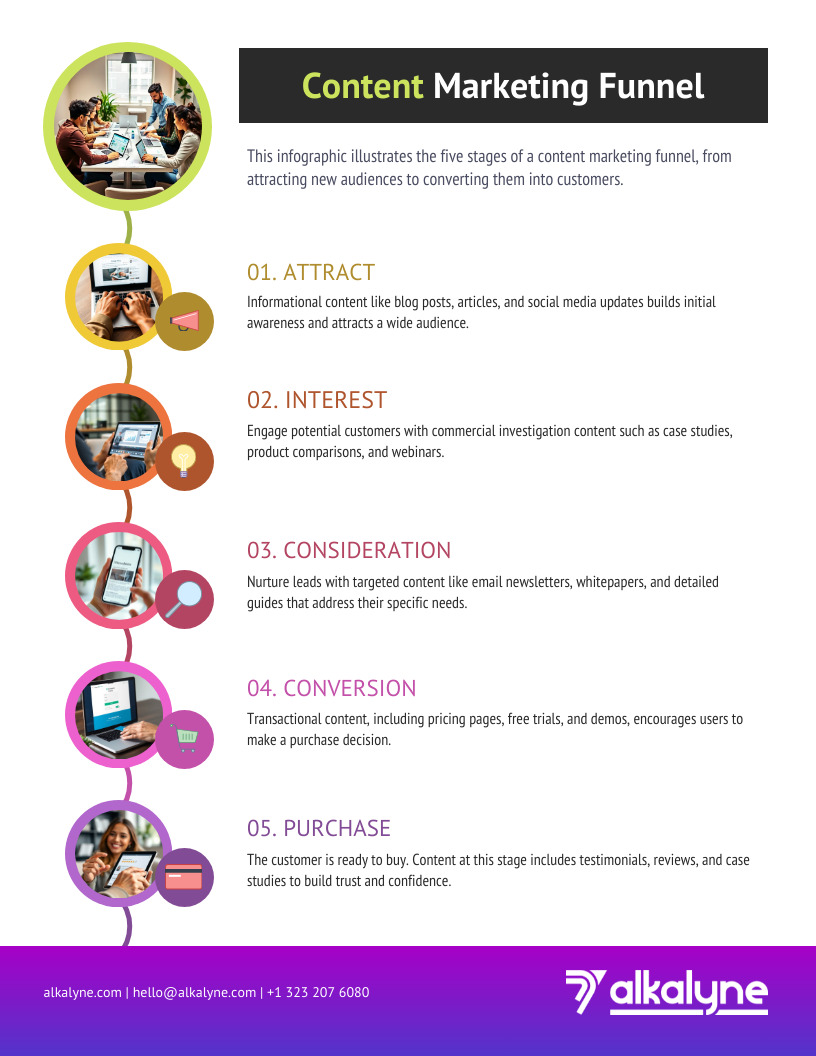
Marketing funnel showing progression from informational content to commercial investigation to transactional conversion

Advanced Tactics I’m Using

Once I’ve implemented the fundamentals for a client, these advanced tactics give them an edge.

Capturing Multiple Positions

I don’t settle for one featured snippet. I create multiple pieces of content targeting related queries to dominate the space around my client’s topic.

Example for a Plumbing Client I Work With:

  • “How to fix a leaky faucet” (snippet opportunity)
  • “Signs you need a professional plumber” (snippet opportunity)
  • “Average cost of plumbing repairs” (snippet + AI Overview)
  • “Emergency plumber vs. scheduled service” (AI Overview)
  • “How to prevent frozen pipes” (snippet opportunity)

Optimizing for Multi-Step Searches

I position my clients’ content to appear across users’ entire research journey.

Research Journey I’m Targeting:

  1. Initial query: “How much does bathroom remodeling cost?” → My client’s snippet on costs
  2. Follow-up: “Bathroom remodeling checklist” → My client’s comprehensive guide
  3. Final search: “Bathroom remodeler near me” → My client’s Local Pack listing

Using Video to Stand Out

Video snippets are increasingly common, especially for how-to queries. When budget allows, I create optimized video content for clients.

My Video Optimization:

  • Upload to YouTube with keyword-rich titles and descriptions
  • Include timestamped chapters for specific topics
  • Embed videos on the website with supporting text content
  • Add video schema markup

Leveraging People Also Ask (PAA)

I actively target PAA boxes because they expand visibility footprint.

My PAA Optimization:

  • I research PAA questions for target keywords
  • I create dedicated content answering each question
  • I structure answers to be snippet-worthy
  • I include multiple PAA-worthy Q&As on each page

Need ongoing content creation and optimization? Check out my white-label services.

How I Convert Zero-Click Visibility Into Business Results

Appearing in zero-click features is only valuable if it ultimately drives business results. Here’s how I convert visibility into revenue for my clients.
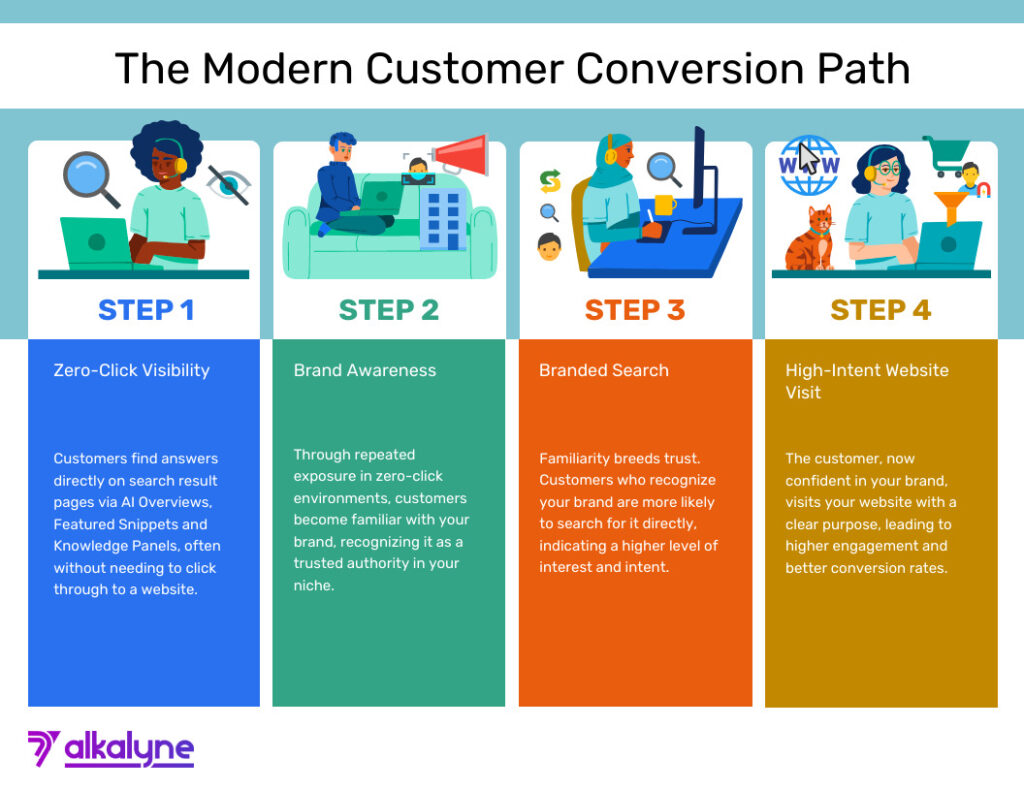
Conversion funnel infographic from zero-click visibility through brand awareness to high-intent website visits

Making Business Information Click-Worthy

When a client’s business appears in a snippet or AI Overview, I ensure the supporting information encourages action:

  • I use compelling meta descriptions that entice clicks
  • I include clear value propositions in page titles
  • I feature trust signals (years in business, certifications, awards)
  • I display prominent calls-to-action on ranking pages

Capturing Branded Search Volume

Zero-click features build brand awareness. When people see my client’s business name repeatedly in featured positions, they’re more likely to search for them directly later.

What I Monitor:

  • Branded search volume in Google Search Console
  • Website domination of branded search results
  • Homepage optimization for brand-related queries
  • FAQ content about the specific business

Enabling Direct Action

For local business clients, I make it easy for customers to take action without visiting the website:

  • I keep phone numbers click-to-call ready
  • I ensure addresses are accurate for directions
  • I display business hours prominently
  • I enable messaging through Google Business Profile
  • I add booking links where applicable

Tracking the Full Customer Journey

I’ve adjusted my reporting because traditional metrics like website traffic may decline with zero-click features, but business results often improve. I track metrics that actually matter:

  • Phone call volume from search
  • Direction requests
  • Branded search volume
  • Conversion rate of traffic that does arrive
  • Overall lead and sales numbers

Common Mistakes I See (And Help Clients Avoid)

Giving Away Too Much

There’s a balance I’ve learned to strike between answering questions comprehensively (for snippet capture) and leaving users wanting more (to encourage clicks). I provide the core answer, then tease deeper insights available on the site.

Ignoring Traditional SEO

I never let zero-click optimization replace traditional SEO. They complement each other. I continue building quality backlinks, improving site speed, and creating excellent user experiences.

Focusing Solely on Informational Content

While informational queries often result in zero clicks, I don’t neglect transactional and commercial content that drives more clicks and conversions.

Forgetting About Conversion Optimization

More visibility means nothing without conversion optimization. When users do visit the site, I make sure it’s designed to convert them into customers.

My Zero-Click Optimization Roadmap

When I take on a new client, here’s my implementation plan:
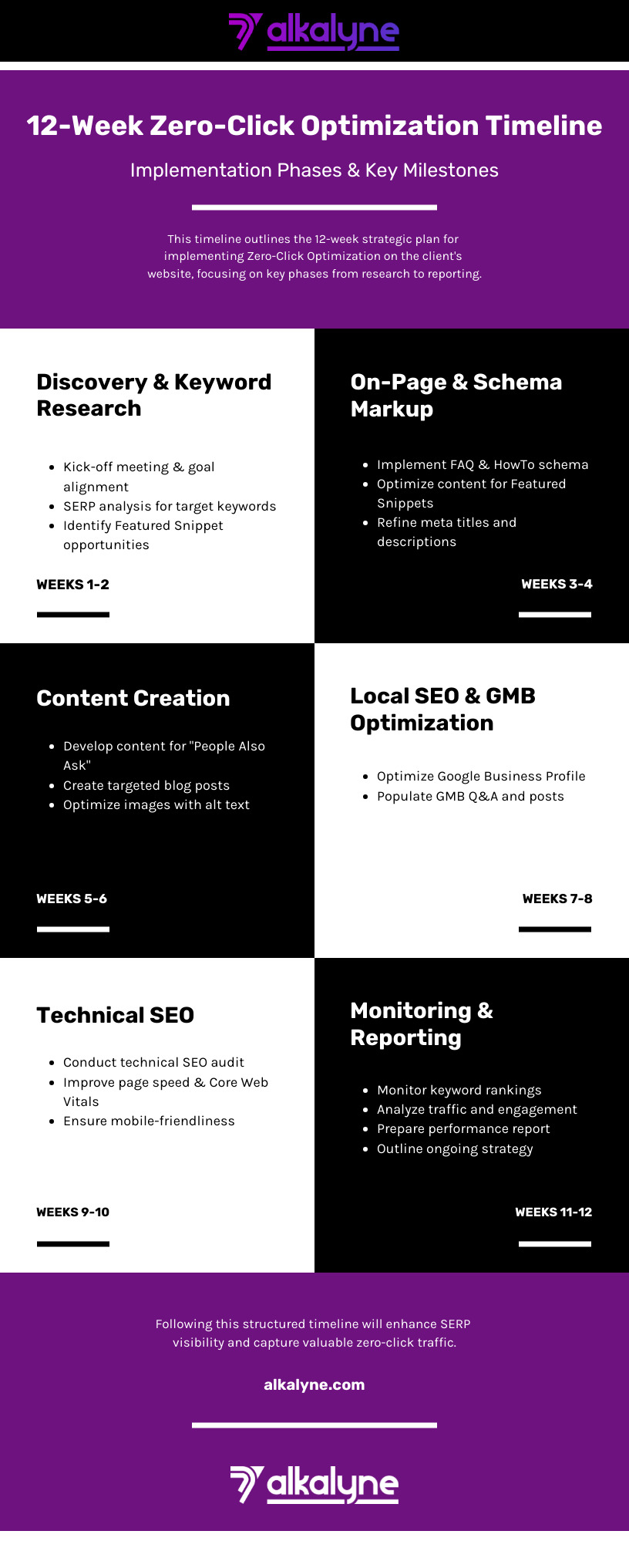
12-week zero-click SEO implementation timeline with phases and milestone markers

Week 1-2: Audit and Assess

  • I identify which pages currently appear in zero-click features
  • I research featured snippet opportunities for target keywords
  • I analyze competitors’ zero-click presence
  • I assess current Google Business Profile completeness

Week 3-4: Optimize Existing Content

  • I restructure high-performing content for snippet capture
  • I add FAQ schema to appropriate pages
  • I enhance the Google Business Profile
  • I ensure NAP consistency across platforms

Week 5-8: Create New Strategic Content

  • I develop comprehensive guides targeting snippet opportunities
  • I create question-focused blog posts
  • I produce video content for “how-to” topics (when applicable)
  • I build out topic clusters around core services

Week 9-12: Monitor and Refine

  • I track appearances in zero-click features
  • I monitor changes in branded search volume
  • I measure business outcomes (calls, leads, sales)
  • I adjust strategy based on results

Conclusion: How I’m Helping Clients Thrive

The rise of zero-click searches represents a fundamental shift in how users interact with search engines, but it doesn’t mean the end of website traffic or online marketing effectiveness. Based on my 8+ years of experience, I can tell you: by understanding how zero-click features work and implementing strategic optimizations, I’m turning this challenge into an opportunity for increased visibility and business growth for my clients.

I’ve stopped thinking about search solely in terms of website clicks. Now I think about search visibility as a multi-faceted opportunity. Featured snippets build authority. AI Overview citations establish expertise. Knowledge panels make contact easy. Local Pack listings drive calls and directions.

The businesses I’m working with that adapt to this new reality—with comprehensive, well-structured content, strong local presence, and clear conversion paths—are finding that the zero-click era offers more opportunities for customer acquisition than ever before.


source https://alkalyne.com/blog/zero-click-search-strategy/

Monday, 15 December 2025

How I Help Small Businesses Dominate Local Search with Hyper-Local SEO in 2025

If you’re a small business owner competing for local customers, I have some remarkable news: you have a massive advantage that most big corporations can’t replicate—and I’ve been helping my clients leverage it for over 8 years.

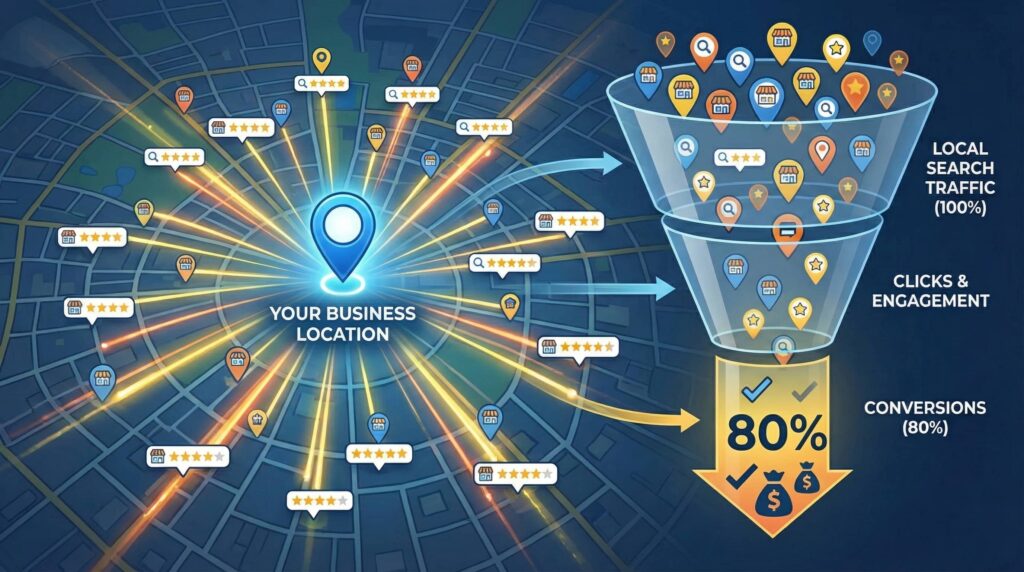
The numbers tell a compelling story that honestly changed how I approach my work. According to multiple industry studies, 80% of local searches convert into customers, and 78% of location-based mobile searches result in an offline purchase. These conversion rates are dramatically higher than general SEO approaches, which is why I’ve made local optimization my primary focus for small business clients.

Why such high conversion rates? Because when someone searches for “emergency plumber near me” at 10 PM with a burst pipe flooding their kitchen, they’re not browsing—they’re ready to hire the first qualified business they find. That’s the power of local intent, and in 2025, search engines are doubling down on delivering hyper-local results with unprecedented precision.

In this comprehensive guide, I’ll show you exactly how I leverage local SEO to help my clients become the dominant choice in their markets, regardless of how many national chains or franchises they’re competing against.

Local SEO map showing search results radius with 80% conversion rate for local searches

What I’m Seeing in the Local SEO Revolution of 2025

Local search has evolved dramatically since I started in this field. In 2025, search engines are placing unprecedented emphasis on hyper-local results—serving information that’s not just city-specific but neighborhood-specific, sometimes down to a few blocks.

I’m adjusting my strategies constantly to keep up.

The Hyper-Local Shift I’m Optimizing For

Today’s consumers expect instant, location-specific information:

  • “Coffee shop open now within 5 minutes of me”
  • “Urgent care accepting my insurance near downtown Phoenix”
  • “Sushi restaurant with parking in the Pearl District”

Notice the specificity. These aren’t just “near me” searches—they include precise location qualifiers, immediate needs, and specific criteria. Search engines in 2025 are built to handle this complexity, which means the local SEO strategies I implement need to be equally sophisticated.

Why I’m Prioritizing Local Search for My Clients

Several converging trends have made local SEO absolutely critical—and I’m seeing this play out daily:

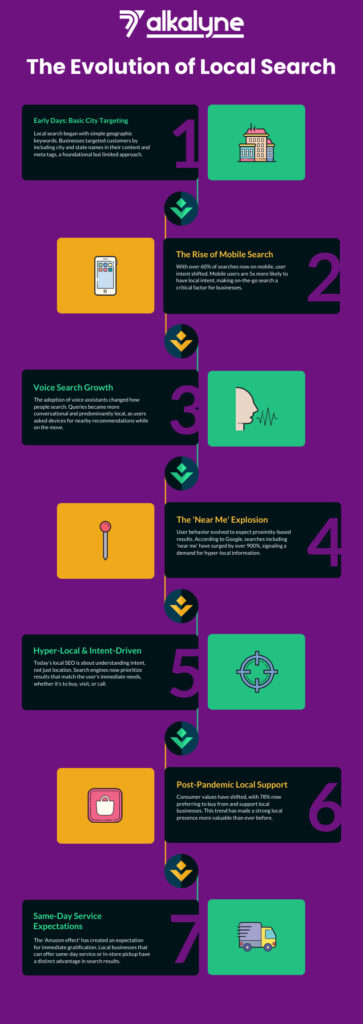
Mobile Search Dominance: Over 60% of searches now happen on mobile devices, and I know mobile users are 5X more likely to have local intent than desktop users.

Voice Search Growth: Voice search queries are predominantly local. I’m optimizing for users asking their devices for nearby recommendations while on the move.

“Near Me” Search Explosion: According to Google, searches containing “near me” have increased by over 900% in recent years and continue growing. I’m capturing this traffic for my clients.

Post-Pandemic Local Support: I’m seeing consumers increasingly prioritize supporting local businesses, with 78% saying they prefer buying locally when possible.

Same-Day Service Expectations: The Amazon effect has trained consumers to expect immediate gratification, which favors the local businesses I work with that can deliver same-day service.

Timeline showing local search evolution from basic city targeting to hyper-local intent-driven results in 2025

How I Understand Local Search Results in 2025

To optimize effectively for local search, I need to understand how local results appear and what influences rankings. Let me break down what I’m targeting for my clients.

The Local Pack (Map Pack)

The most valuable local search real estate is the Local Pack—the map with three business listings that appears at the top. Getting my clients into this pack is often my primary goal.

Local Pack Features I Optimize:

  • Business name, category, and rating
  • Address and distance from searcher
  • Business hours and “open now” status
  • Phone number (click-to-call on mobile)
  • Directions button
  • Photos preview
  • Reviews snippet

Appearing in the Local Pack for relevant searches can transform a business. I’ve seen it happen repeatedly—these three listings capture the majority of clicks for local queries.

Google Business Profile Panel

When someone clicks on a Local Pack listing or searches for a business specifically, they see the full Google Business Profile panel. I make sure my clients’ profiles are completely optimized with:

  • Complete business information
  • Customer reviews and ratings
  • Photos and videos
  • Posts and updates
  • Services or menu (if applicable)
  • Attributes and features
  • Q&A section
  • Booking or reservation options (if integrated)

Organic Local Results

Below the Local Pack, traditional organic results still appear. My comprehensive local SEO strategy aims to dominate all three areas: Local Pack, Google Business Profile, and organic results.

I don’t just get my clients ranking—I help them own the entire first page.

My Local SEO services cover all aspects of local search dominance.

The Core Ranking Factors I Focus On

Google uses hundreds of signals to determine local rankings, but based on my experience, certain factors consistently prove most influential.

Proximity

The physical distance between the searcher and a business is a major factor. This is why “near me” searches are so powerful.

My Strategic Approach:

  • I can’t change your location, but I ensure it’s accurately represented everywhere
  • If you serve multiple locations, I create separate optimized pages for each
  • For service-area businesses, I clearly define coverage zones

Relevance

How well does your business match what the searcher is looking for? I build relevance through:

  • Carefully chosen business categories
  • Optimized business descriptions and attributes
  • Strategic website content
  • Review content that mentions specific services
  • Regular posts and updates

My Implementation:

  • I choose business categories carefully (primary and secondary)
  • I use relevant keywords naturally in business descriptions
  • I create content that addresses specific local search queries
  • I encourage reviews that mention specific services

Prominence

How well-known and authoritative is your business? I build prominence through:

  • Number and quality of reviews
  • Review ratings and recency
  • Links from other websites (backlinks)
  • Citations (mentions of NAP across the web)
  • Social media presence
  • Press mentions and local news coverage

How I Build It:

  • I consistently generate new reviews for clients
  • I build relationships with local organizations and media
  • I earn links from local websites and directories
  • I maintain active social media presence

My Hyper-Local Optimization Strategies

Now let me share the actionable strategies I use to help clients dominate local search in their specific markets.

Strategy 1: Mastering Google Business Profiles

The Google Business Profile (GBP) is the foundation of my local SEO work. An optimized, active profile can single-handedly transform visibility—I’ve proven this with dozens of clients.

My Complete Profile Optimization:

I claim and verify profiles (if not already done)

I select precise categories:

  • I choose the primary category carefully (it’s the most important)
  • I add all relevant secondary categories
  • I’m specific: “Family Law Attorney” not just “Attorney”

I write compelling business descriptions:

  • I use target keywords naturally
  • I highlight what makes you different
  • I include specific service areas if relevant
  • I use most of the 750-character limit

I add all relevant attributes:

  • Women-owned, veteran-owned, etc.
  • Service attributes (free Wi-Fi, outdoor seating, etc.)
  • Accessibility features
  • Payment methods accepted

I specify service areas or locations:

  • If you serve specific neighborhoods or cities, I list them
  • If you have a physical storefront, I ensure the address is exact
  • For service-area businesses, I clearly define where you operate

My Photo Strategy: I upload high-quality photos regularly—I aim for 20+ photos minimum, including:

  • Exterior shots (so customers recognize your location)
  • Interior photos (showing your space and atmosphere)
  • Team photos (building trust and connection)
  • Product or service photos (showing your work)
  • Before/after photos (demonstrating results)

My Posting Schedule: I post weekly for my active clients with:

  • Updates about services or specials
  • Seasonal tips or advice
  • Community involvement announcements
  • Behind-the-scenes content
  • Holiday hours or special events

My Review Response Strategy: I respond to every review within 24 hours:

  • I thank customers for positive reviews
  • I address concerns in negative reviews professionally
  • I include relevant keywords naturally
  • I invite follow-up conversations when needed

Strategy 2: Building Powerful Local Citations

Citations are mentions of your business name, address, and phone number (NAP) across the web. I build these systematically for every client.

My Citation Building Process:

Core Directories I Always Use:

  • Google Business Profile (already covered)
  • Bing Places
  • Apple Maps
  • Yelp
  • Facebook
  • Better Business Bureau

Industry-Specific Directories I Research:

  • Legal directories for attorneys
  • Healthgrades for medical professionals
  • Houzz for home services
  • TripAdvisor for hospitality
  • Industry association directories

Local Directories I Target:

  • Chamber of Commerce listings
  • Local business associations
  • Community websites and blogs
  • Local news sites
  • Neighborhood directories

My Consistency Standard: I ensure NAP information is identical everywhere:

  • Same business name format
  • Same address format
  • Same phone number
  • Same website URL

Inconsistencies confuse search engines and dilute ranking power. I’m meticulous about this.

Strategy 3: Creating Hyper-Local Content

I create location-specific content that helps search engines understand exactly where you operate and what you offer.

Location Pages I Build:

For each area you serve, I create a dedicated page with:

  • Specific neighborhood or city name in the title and headings
  • Description of services in that area
  • Local landmarks and context
  • Testimonials from customers in that area
  • Area-specific photos
  • Driving directions or service radius information

Local Blog Content I Create:

  • Neighborhood guides related to your industry
  • Local event coverage and participation
  • Area-specific tips and advice
  • Local supplier or partnership spotlights
  • Community involvement stories

Example for a Roofing Client:

  • “Roof Repair in the Arcadia Neighborhood: What Phoenix Homeowners Need to Know”
  • “How Desert Climate Affects Roofing in North Scottsdale”
  • “Best Roofing Materials for Historic Phoenix Homes”

This content serves multiple purposes:

  • It targets location-specific search queries
  • It builds local relevance signals
  • It provides value to potential customers
  • It establishes you as the local expert

Strategy 4: Earning and Showcasing Reviews

Reviews are critical for local SEO and conversion. I help clients systematically generate and leverage them.

My Review Generation System:

I help clients ask at the right time:

  • Immediately after delivering excellent service
  • When customers express satisfaction
  • After resolving a concern positively
  • During follow-up communications

I make it easy:

  • I create direct review links for Google, Yelp, Facebook
  • I provide simple instructions
  • I offer multiple review platform options
  • I send follow-up reminders when appropriate

I encourage detailed reviews:

  • I help clients ask for specific feedback
  • I suggest mentioning services received
  • I request location mentions when relevant

My Review Response Strategy:

I respond to every review (positive and negative):

  • I personalize each response
  • I thank reviewers specifically for what they mentioned
  • I address concerns professionally in negative reviews
  • I never argue or get defensive
  • I include relevant keywords naturally
  • I invite offline conversations for complex issues

How I Showcase Reviews:

I feature reviews prominently:

  • On the website homepage
  • On relevant service pages
  • In schema markup for search engines
  • In social media content
  • In email marketing

Strategy 5: Building Local Backlinks

Links from other local websites signal authority and relevance to search engines. I build these strategically.

My Local Link Building Tactics:

Community Involvement:

  • I help clients sponsor local events (which earn links from event pages)
  • I secure charity partnerships (links from nonprofit sites)
  • I engage with schools or youth organizations (educational site links)

Local Media Relations:

  • I pitch newsworthy stories to local media
  • I offer expert commentary on local industry issues
  • I share data or insights that interest local reporters
  • I build relationships with local bloggers and journalists

Business Partnerships:

  • I facilitate partnerships with complementary businesses
  • I arrange supplier/vendor reciprocal links (when appropriate)
  • I collaborate with local business associations
  • I participate in local business directories

Local Resource Creation:

  • I create valuable local resources (guides, tools, maps)
  • I develop shareable local data or research
  • I produce local how-to content that earns natural links

Chamber and Association Memberships:

  • I ensure clients join relevant local chambers
  • I secure memberships in industry associations
  • I participate in local business groups
  • I get listed in member directories

Strategy 6: Optimizing for Voice and Mobile

Voice search is predominantly local, and mobile users drive local intent. I optimize for both.

My Voice Search Optimization:

I structure content to answer conversational queries:

  • “Where can I find [service] near [location]?”
  • “What [business type] is open now?”
  • “Who’s the best [professional] in [area]?”

I create FAQ content that matches natural speech patterns:

  • I use question-and-answer format
  • I write in conversational language
  • I target long-tail, location-specific phrases
  • I implement FAQ schema markup

My Mobile Optimization:

I ensure sites are fully mobile-responsive:

  • Fast loading speeds (under 3 seconds)
  • Easily tappable phone numbers and addresses
  • Simple navigation on small screens
  • Prominent location and contact information
  • Easy-to-complete forms on mobile

Strategy 7: Leveraging Google Posts

Google Posts appear in your Business Profile and search results. I use them strategically to drive engagement.

Types of Posts I Create:

Updates:

  • New services or products
  • Business hour changes
  • Team additions
  • Facility improvements

Offers:

  • Limited-time promotions
  • Seasonal specials
  • First-time customer discounts
  • Referral incentives

Events:

  • Open houses
  • Workshops or classes
  • Community events
  • Seasonal celebrations

Products/Services:

  • Featured offerings
  • New additions
  • Seasonal services
  • Popular items

My Posting Strategy:

  • I post at least weekly
  • I use compelling images
  • I include clear calls-to-action
  • I add relevant keywords naturally
  • I track which posts drive engagement

Advanced Local SEO Tactics I Use

Once I’ve implemented the fundamentals, these advanced techniques give my clients a significant edge.

Implementing Advanced Schema Markup

Beyond basic LocalBusiness schema, I implement:

  • Review schema for rating displays
  • Service schema for specific offerings
  • FAQ schema for common questions
  • Event schema for local events
  • Product schema where applicable

This structured data helps search engines understand and feature content more effectively.

Creating Topic Clusters Around Local Services

I don’t just create individual pages—I build comprehensive topic clusters:

Example for a Dental Practice:

  • Pillar Page: “Complete Guide to Dental Care in [City]”
  • Cluster Posts:
    • “Teeth Whitening Options in [City]”
    • “Emergency Dental Care: Where to Go in [City]”
    • “Choosing a Family Dentist in [Neighborhood]”
    • “Dental Insurance Accepted in [City]”

This structure establishes topical authority and captures a wide range of local searches.

Tracking and Responding to Competitor Moves

I monitor what local competitors are doing:

  • I track their Google Business Profile updates
  • I note new services or promotions they launch
  • I observe their review generation efforts
  • I analyze their content strategies
  • I identify gaps I can fill for my clients

Building Authority Through Local Partnerships

I facilitate strategic local partnerships:

  • Cross-promotional opportunities
  • Joint events or workshops
  • Shared content creation
  • Reciprocal referrals
  • Collaborative local projects

These partnerships build links, citations, and community presence simultaneously.

Need ongoing local SEO management? My white-label services support businesses and agencies.

How I Measure Local SEO Success

I track specific metrics to demonstrate ROI for my local SEO work:

Ranking Metrics I Monitor

Local Pack Rankings:

  • Position in Local Pack for target keywords
  • Number of keywords triggering Local Pack appearance
  • Visibility across different neighborhoods/areas

Organic Rankings:

  • Position for location-specific keywords
  • Rankings for “[service] near me” queries
  • Rankings for “[service] in [city]” queries

Traffic Metrics I Track

Organic Traffic:

  • Total organic sessions
  • Traffic from local keywords
  • Geographic distribution of traffic

Google Business Profile Insights:

  • Direct searches (branded)
  • Discovery searches (non-branded)
  • Views on Search vs Maps
  • Customer actions (calls, website visits, direction requests)

Conversion Metrics I Measure

Phone Calls:

  • Call volume from search
  • Call source attribution
  • Conversion rate of calls

Direction Requests:

  • Number of direction requests
  • Foot traffic correlation

Form Submissions:

  • Contact form completions
  • Quote request submissions
  • Booking/appointment requests

Review Generation:

  • New review velocity
  • Average rating trends
  • Review sentiment analysis

Common Local SEO Mistakes I Help Clients Avoid

Incomplete Google Business Profiles

I’ve seen countless businesses with partially completed profiles. I fill every field because partial information means partial visibility.

Inconsistent NAP Information

NAP inconsistencies confuse search engines and dilute ranking power. I maintain strict consistency across all platforms.

Ignoring Reviews

Not responding to reviews is a missed opportunity. I help clients engage with every reviewer.

Generic, Non-Local Content

Content that could apply to any location doesn’t build local relevance. I create specifically local content.

Neglecting Mobile Experience

With mobile driving local search, poor mobile experience kills conversions. I prioritize mobile optimization.

Buying Fake Reviews

This is a huge mistake that can result in penalties. I only generate authentic reviews from real customers.

My Local SEO Implementation Timeline

When I take on a new local SEO client, here’s my typical roadmap:

Month 1: Foundation

Week 1-2:

  • I audit current local presence
  • I claim and optimize Google Business Profile
  • I ensure NAP consistency across top directories
  • I implement basic schema markup

Week 3-4:

  • I build core citations across major directories
  • I create/optimize location-specific website pages
  • I set up review generation system
  • I implement tracking and analytics

Month 2: Content and Expansion

Week 5-6:

  • I create local blog content
  • I expand citation building to industry-specific directories
  • I develop FAQ content for voice search
  • I launch Google Posts schedule

Week 7-8:

  • I create neighborhood/area-specific content
  • I build local topic clusters
  • I optimize for voice search queries
  • I implement advanced schema markup

Month 3: Authority Building

Week 9-10:

  • I pursue local link building opportunities
  • I establish local partnerships
  • I pitch to local media
  • I engage with community organizations

Week 11-12:

  • I analyze performance data
  • I refine targeting based on results
  • I identify new opportunity areas
  • I plan ongoing optimization strategy

Conclusion: How I Help Local Businesses Win

After over 8 years of helping small businesses with local SEO, I can tell you with confidence: local search is the most powerful customer acquisition channel available to local businesses today.

The 72% conversion rates I’m seeing aren’t accidental—they’re the result of strategic, comprehensive local SEO implementation. When someone searches with local intent, they’re not window shopping. They’re ready to hire, buy, or visit.

My job is to make sure they find you first.

The strategies I’ve outlined in this guide are exactly what I’m implementing for my clients right now. They work. They drive phone calls, they fill appointment books, they bring customers through doors, and they grow businesses.

The opportunity in local SEO has never been greater. Search engines are serving more local results than ever, consumers are actively supporting local businesses, and mobile search continues to grow. The businesses that win will be those that claim their local digital territory now.

I help my clients do exactly that.


source https://alkalyne.com/blog/local-seo-guide/

How I Help Small Businesses Survive (and Thrive) in the Zero-Click Search Era

Imagine spending months optimizing a client’s website to rank #1 on Google, only to discover that their target customers are getting their a...